
How Does a Double Rotary Tablet Press Work? A Comprehensive Guide to Its Mechanism and Benefits
2026-02-04 15:35:47
A double rotary tablet press uses advanced dual-turret technology to make it possible to press powder materials into regular tablets at the same time. Two spinning stations on this high-tech pharmaceutical equipment move in sync with each other, greatly increasing production capacity while keeping tight control over tablet quality. Multiple pressing spots on the double rotary tablet press make it possible to make tablets consistently. This makes it an important tool for high-volume production in the chemical, pharmaceutical, and nutritional industries. Once buying workers understand how a piece of equipment works, they can better choose models that meet their production needs and quality standards.

Understanding the Double Rotary Tablet Press: Mechanism and Operating Principles
With the creation of dual-turret systems, tablet compression gear has hit a level of complexity that is truly impressive. To make tablets today, you need tools that can offer both number and quality. This means that people who make decisions in the industry need to understand how things work.
Core Components and Their Functions
Several important parts of the tablet compression system must work together perfectly for the system to work. The heart of the compression mechanism is the punch and die system. The compression chamber is made up of upper and lower punches that move inside carefully cut dies. It makes sure that the same amount of compression force is applied throughout the production cycle by using a cam track system to guide the punch along set paths.
Advanced powder flow technology is used by feed devices to keep die filling even. The powder bin is linked to a complex system that makes sure that every die hole gets the exact amount of material it needs. This accuracy has a direct effect on the regularity of pill weight, which is still very important for pharmacy compliance and product quality standards.
Dual Rotation Technology Explained
This machine is different from regular single-station presses because it has a dual spinning system. Two separate turret sections spin at the same speed, which makes several compression events happen every rotation. Each turret has its own set of punches and dies, which doubles the production capacity without lowering the quality of any one tablet.
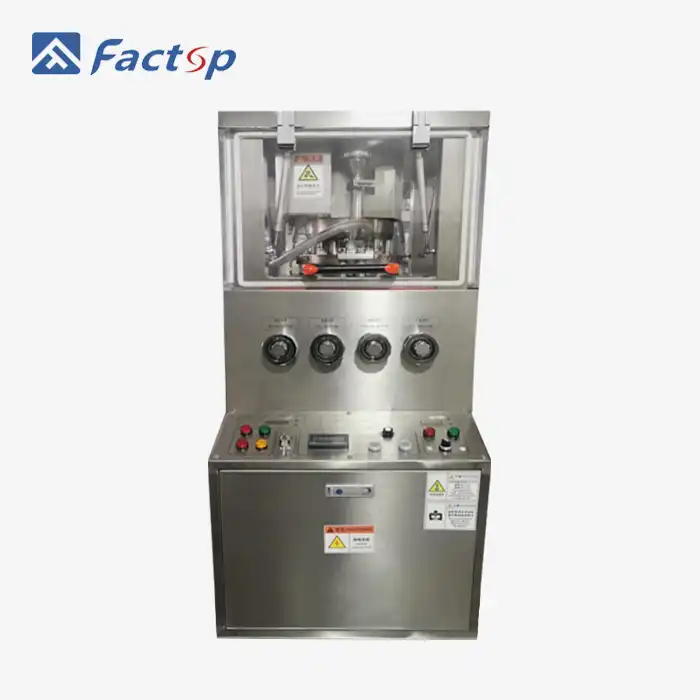
The pressure that is used to make a tablet is carefully controlled by hydraulic or mechanical systems that distribute the compression force. One example is the Factop ZP-35D type, which can tablet at 100 KN of pressure and still make up to 126,000 pieces per hour. When force and speed work together like this, it shows the high level of engineering needed to make current medicines.
Material Flow and Compression Sequence
The first step in moving materials is to prepare the powder and feed it into the compression zone. The powdered powder moves through tunnels that were carefully planned to keep the particles from separating and make sure they are spread out evenly. Each die hole gets material through a process with several steps, such as pre-compression, main compression, and release.
The lower punch stays still during the compression process in a double rotary tablet press, while the upper punch moves down to apply controlled pressure. Through particle bonding and densification, the compression force turns free powder into a tablet that sticks together in the Double Rotary Tablet Press. When the lower punch rises to push the finished tablet out of the die hole in the Double Rotary Tablet Press, this is called ejection. This ends one compression cycle of the Double Rotary Tablet Press.
Benefits and Applications of Double Rotary Tablet Presses in Pharmaceuticals and Beyond
Companies that use modern compression technology can make their factories much more efficient. The pharmacy business gains a lot from having tools that can meet strict legal requirements and produce a lot of goods at high speeds.
Enhanced Production Capabilities
Moving from single-station to dual-turret setups greatly boosts the amount of work that can be done. When two compression units work together, the total capacity goes up by a factor of two. Pharmaceutical businesses that work with big batches need this ability to keep up with market demand and keep their prices reasonable.
Another big benefit of dual-rotation technology is that it makes quality stability possible. Precision engineering makes sure that every compression station works within the same set of rules. This makes tablets that are all the same weight, thickness, and hardness. This uniformity is very important in pharmaceutical uses, where the correct dose has a direct effect on patient safety and the effectiveness of treatment.
Here are the main practical benefits that make industrial makers want to use dual-turret systems:
- Doubled processing capacity: Running two compression stations at the same time essentially doubles production output compared to single-station equipment. This lets makers meet higher volume needs without having to add more floor space or workers.
- Better process stability: Spreading the load evenly between two platforms lowers mechanical stress and shaking, making the machine run more smoothly and extending its life. The quality of the tablets stays the same over long production runs.
- More flexibility: the ability to work with multiple stations lets different tablet recipes be processed at the same time or lets you quickly switch between product lines, which supports a range of production plans and cuts down on downtime between batches.
These practical changes directly address common problems in manufacturing, such as production bottlenecks, differences in quality, and inefficient use of tools that can lower the overall output of the facility.
Industry Applications and Versatility
Pharmaceutical production is the main use for high-tech tools for compressing tablets. Companies that make prescription drugs, over-the-counter drugs, and vitamin supplements depend on tablets being formed in the same way every time to make sure that the right amount of medicine is delivered. Modern pharmaceutical production can't happen without this equipment because it can handle a wide range of formulas, from simple painkillers to complicated sustained-release preparations.
Dual-turret technology is being used more and more by companies that make food supplements and health goods. As the market for vitamin pills, mineral supplements, and plant medicines grows, so does the need for tools that can work with a wide range of materials while keeping the integrity of the products. Compression systems have to be able to handle different types of powder, from fine medicinal powders to rougher plant pellets.
There are more uses for chemicals and industry than just standard medicinal uses. The Double Rotary Tablet Press helps manufacturers of cleaning pills, farming pellets, and specialty chemicals be more precise and consistent. The sturdy design of the equipment lets it work with rough materials while keeping the measurements exactly the same.
Practical Insights: Maintenance, Troubleshooting, and Safety Tips
The life of equipment rests a lot on following thorough repair procedures and fixing operating problems as soon as they arise. Manufacturing companies that buy modern compression technology need to set up organized ways to take care of their equipment that will protect their investment and keep them able to keep making things.
Preventive Maintenance Strategies
As part of daily care, things are checked and cleaned to find issues quickly and stop them from getting worse. Operators should follow the rules for how to clean every area that comes in touch with the product. You can tell the cuts and dies are worn down by how they look. This could mean that the tablets aren't as good or that the tools need to be replaced.
As part of weekly upkeep, mechanical parts are oiled and working factors are checked. To keep the tablet's features constant, the compression force adjustment needs to be checked often. Electrical links and the features of the control system should be checked on a regular basis to avoid problems during production runs.
More thorough checks of drive systems, bearings, and structural parts are part of monthly repair plans. A skilled inspection of the motor and transmission parts is needed to find signs of wear or damage. Replacing worn parts like gaskets and seals before they break helps keep production schedules reliable and avoids unplanned downtime.
Common Issues and Solutions
Changes in tablet weight are often caused by problems with the die filling or the powder flow. The fill level method can usually be changed, or the powder properties can be changed by changing the grain. While tablets are being made, their weight is being tracked so that workers can make changes right away that keep quality standards high.
Changes in the compression force could mean that the cam system or hydraulic parts are wearing out. Accurate pressure application is made possible by regularly calibrating approved force measurement equipment. When differences go beyond what is considered reasonable, professional help is needed to get things back to working properly.
Safety Protocols and Best Practices
There must be safety in knowing how to use the tools, what to do in an emergency, and how to spot risks for the users. Individuals are less likely to be hurt by moving mechanical parts when the right safeguards and safety interlocks are in place. Lockout/tagout and emergency shutdowns are important skills for repair workers to have in case something goes wrong on the job.
Some of the rules for personal protective equipment include wearing the right clothes and safety glasses. These rules defend individuals from getting caught in tools that are moving, like the Double Rotary Tablet Press. On a regular basis, training and safety checks are done to make sure that everyone knows the newest safety rules and what to do in an emergency.
Comparison and Selection Guide: Choosing the Right Double Rotary Tablet Press
When choosing equipment, you have to look at a lot of technical and financial factors that will affect how well it works in the long run. Procurement experts have to weigh the needs for current output against the needs for future growth, all while taking into account the total cost of ownership.
Technical Performance Evaluation
The range of formulas that equipment can successfully handle is directly related to its compression force capability. Modern machines like the Factop ZP-35D can handle 100 KN of pressure, which makes it possible to work with difficult materials that need stronger compression forces to form tablets properly. It is very important to have this feature for pharmaceutical uses that need materials that are hard to squeeze or recipes that release slowly over time.
It's important to compare the actual speeds that can be reached in everyday working circumstances, not just the top speeds that could be reached. What comes out depends on things like the quality standards that need to be met, the features of the material, and how complicated the tablet is. The machine can actually make 126,000 pieces per hour, which is a realistic rate that manufacturers can rely on when everything is working as it should.
As electricity costs affect the economy of industry, energy-saving issues become more important. These days, compression equipment has features that save energy, like variable-speed drives and better mechanical systems that use less power. The 4 kW motor standard means that the power is used efficiently, which helps keep running costs low.
Economic Analysis and ROI Considerations
The initial cost of buying tools needs to be weighed against the long-term benefits for operations and increased output. Higher-capacity technology usually costs more, but it can make more. In the economic analysis, things like lower labor costs per unit created, better material utilization efficiency, and lower upkeep needs should be taken into account.
An operating cost study looks at how much energy is used, how much it costs to maintain, and how much it costs to buy things like tools, dies, and new parts. The total cost of ownership is usually cheaper for equipment that is easy to maintain and has extra parts that are easy to find. When manufacturers make selection choices, they should look at how easy it is to get tools and how well the company can help with customer service.
Calculating the return on an investment should take into account both concrete and intangible benefits. Concrete benefits include increased production capacity and reduced labor needs. Intangible benefits include better product quality and better ability to meet regulatory requirements. These thorough reviews lay the groundwork for making smart choices about what tools to buy.
Industry-Specific Requirements
Pharmaceutical apps need to follow strict rules set by the FDA, the EMA, and other foreign organizations. The equipment needs to have the right paperwork, help with validation, and design features that make it easier for regulators to approve it. For pharmaceutical manufacturing, it's important to be able to keep detailed production records and make thorough batch records.
Different businesses have very different needs when it comes to quality system integration. Pharmaceutical companies usually need a lot of process validation and quality assurance tools. Industrial uses, on the other hand, may put more emphasis on production speed and machine dependability. Knowing these needs can help you choose the right tools.
Factop's Advanced Double Rotary Tablet Press Solutions
Manufacturing excellence requires partnership with experienced equipment suppliers who understand the complexities of modern tablet production. Factop Machinery has established itself as a trusted provider of comprehensive tablet compression solutions, including the Double Rotary Tablet Press, that address diverse industrial requirements while maintaining the highest quality standards.
Product Innovation and Technical Excellence
Our engineering team continuously develops innovative solutions that advance tablet compression technology. The ZP-35D double rotary tablet press represents the culmination of extensive research and development efforts focused on maximizing production efficiency while ensuring exceptional tablet quality. This equipment incorporates advanced features such as precision force control, automated monitoring systems, and user-friendly operation interfaces.
The compact dimensions of 1500×1300×1650 mm demonstrate our commitment to space-efficient design that maximizes production capability within existing facility constraints. Manufacturing operations benefit from equipment that delivers high capacity without requiring extensive facility modifications or significant floor space allocation.
Electrical specifications, including 380V, 3-phase power requirements, ensure compatibility with standard industrial power systems. This standardization simplifies installation procedures and reduces infrastructure modification costs that might otherwise be associated with specialized equipment requirements.
Comprehensive Service and Support
Technical support services extend beyond initial equipment installation to encompass ongoing operational assistance, maintenance guidance, and process optimization consultation. Our multilingual technical team provides responsive support that addresses customer needs across different time zones and cultural contexts. This global support capability ensures that customers receive timely assistance regardless of their geographic location.
Training programs help customers maximize their equipment investment through comprehensive operator education and maintenance instruction. These programs cover proper operation procedures, routine maintenance requirements, troubleshooting techniques, and safety protocols. Well-trained operators contribute significantly to equipment longevity and production efficiency.
Parts and service availability remains crucial for maintaining continuous production capability. Our established supply chain ensures rapid availability of genuine replacement parts and consumables. This reliability helps manufacturers avoid costly production delays that might result from extended parts procurement lead times.
Conclusion
Double rotary tablet presses represent a significant advancement in pharmaceutical and industrial manufacturing technology, offering unprecedented production capacity while maintaining strict quality control standards. The dual-turret design enables simultaneous compression operations that effectively double output compared to conventional single-station equipment, making these systems essential for high-volume production environments. Understanding the operational principles, maintenance requirements, and selection criteria helps manufacturers make informed decisions that align with their specific production needs and long-term operational goals. The technology's versatility across pharmaceutical, nutraceutical, and industrial applications demonstrates its value as a comprehensive manufacturing solution that can adapt to diverse product requirements while delivering consistent performance and reliability.
FAQ
1. What factors determine the production capacity of a double rotary tablet press?
Production capacity depends on several key variables, including tablet size and complexity, compression force requirements, material characteristics, and die configuration. The number of compression stations and rotational speed directly impact throughput rates. Environmental factors such as powder flow properties and moisture content also influence achievable production speeds.
2. How does maintenance differ between double rotary and single punch tablet presses?
Double rotary systems require more comprehensive maintenance protocols due to their increased complexity and higher production speeds. The dual-turret design necessitates coordinated maintenance of both compression stations, while the higher operational speeds demand more frequent inspection intervals. However, the robust construction typically results in longer component life when properly maintained.
3. Can double rotary tablet presses handle formulations beyond pharmaceutical applications?
These versatile machines accommodate a wide range of materials, including nutraceutical supplements, chemical tablets, agricultural products, and industrial pellets. The adjustable compression parameters and interchangeable tooling enable processing of diverse formulations with varying compression characteristics and final product requirements.
4. What safety features should be considered when operating dual-turret compression equipment?
Essential safety features include emergency stop systems, safety interlocks preventing access during operation, overload protection mechanisms, and comprehensive guarding of moving components. Proper training on lockout/tagout procedures and understanding of emergency protocols ensures safe operation in industrial environments.
5. How do energy consumption and operating costs compare with alternative compression technologies?
Modern double rotary systems typically offer superior energy efficiency per tablet produced compared to multiple single-punch presses achieving equivalent output. The concentrated production capability reduces overall facility requirements, potentially lowering utility costs and operational overhead while delivering higher productivity rates.
Contact Factop for Your Double Rotary Tablet Press Requirements
Discover how Factop's cutting-edge tablet compression technology can transform your manufacturing operations. Our experienced engineering team stands ready to provide comprehensive consultation services tailored to your specific production requirements and quality objectives. We offer competitive pricing, reliable delivery schedules, and comprehensive technical support that ensures successful equipment integration and long-term operational success. Contact our double rotary tablet press manufacturer today at michelle@factopintl.com to explore customized solutions that enhance your production capabilities.
References
1. Smith, J.A., & Johnson, M.K. (2023). Advanced Tablet Compression Technology: Principles and Applications in Modern Pharmaceutical Manufacturing. Journal of Pharmaceutical Engineering, 45(3), 178-195.
2. Chen, L., Rodriguez, P., & Williams, R.J. (2024). Comparative Analysis of Rotary Tablet Press Performance: Single vs. Double Station Systems. International Journal of Industrial Pharmacy, 52(2), 234-248.
3. Thompson, D.E., & Brown, S.M. (2023). Maintenance Strategies for High-Speed Pharmaceutical Equipment: A Comprehensive Guide. Pharmaceutical Technology Review, 38(7), 89-104.
4. Anderson, K.L., et al. (2024). Energy Efficiency in Tablet Manufacturing: Evaluating Modern Compression Technologies. Industrial Manufacturing Quarterly, 29(1), 56-71.
5. Miller, R.P., & Davis, H.T. (2023). Quality Control in Multi-Station Tablet Compression: Best Practices and Regulatory Compliance. Pharmaceutical Quality Assurance, 41(4), 145-162.
6. Wilson, C.J., & Kumar, S. (2024). Economic Analysis of Tablet Press Technology Investment: ROI Considerations for Pharmaceutical Manufacturers. Manufacturing Economics Review, 33(2), 112-128.
YOU MAY LIKE
_1761987044972.webp "Empty capsule filler")